

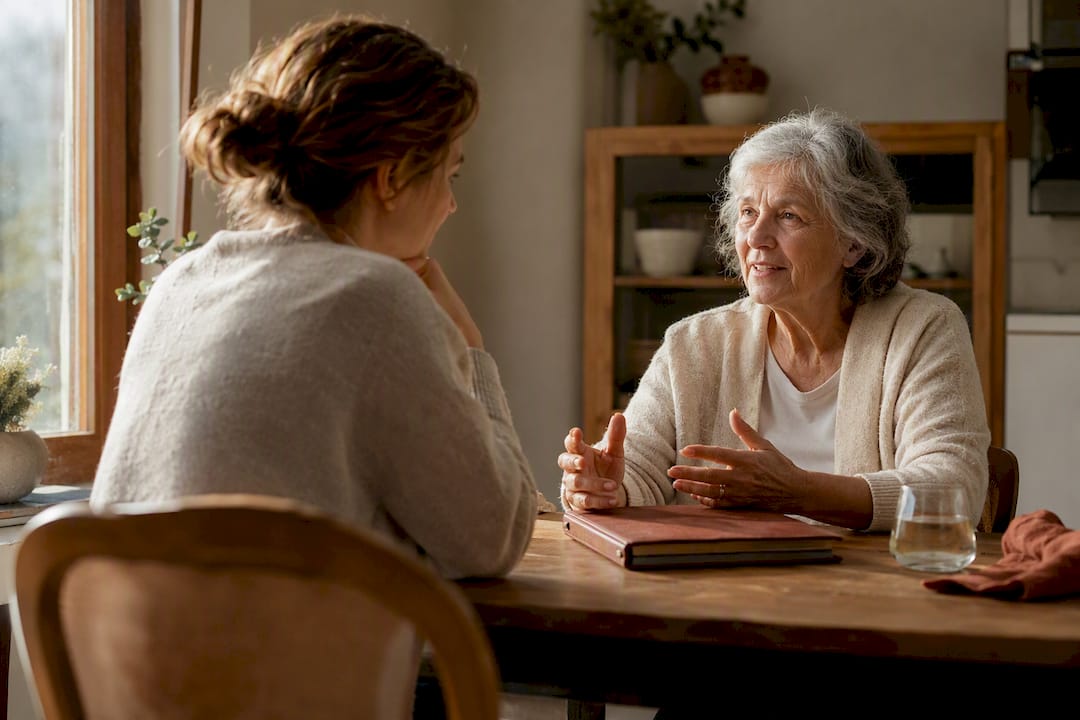
You do not need a list of sixty questions. Send Grandma or Grandpa one to three questions a few days ahead. Take thirty to sixty minutes. Put a photo or a cup on the table. Record the voice. That is enough to start.
What a good question actually does
Search in the United States and you mostly find long lists. Ninety-nine questions. A hundred questions. Many titles add “while you can.”
A long list feels like school. Grandma sits there waiting for the next number. That is the opposite of a visit.
Good questions are small and open. They show a picture: the house, the first day of school, the song from those years. FamilySearch groups that kind of open, themed question. Yes-no questions close the door. “Were you happy as a child?” often gets one word. “What did the house you grew up in look like?” brings the stairs, the smell, the neighbor.
If you later need more questions than one hour can hold, use the questions to ask your parents about their life. The same openness works for grandparents. How many questions a whole life story needs is in life story questions.
Three small groups are enough
Take three groups. Not more for the first afternoon.
Childhood and ordinary days
- What did the house you grew up in look like?
- Who were your best friends, and what did you do together?
- What did a normal afternoon look like at your place?
- What was your favorite food as a child?
Family, places, work
- What were your parents’ full names, and where were they born?
- Did you move, and why?
- What work did you do, and how was the first day?
- Which event shaped the family most?
Relationships and what should remain
- How did you two meet?
- What would you like your grandchildren to keep from you?
- Is there a story that always came up at home?
- Is there a song or a smell that takes you straight back?
Ten to twelve questions are enough for one sitting. A German grandchildren list already stops at ten. The pace is right. Skip the line that says you have to ask before it is too late. If one story fills the afternoon, drop the rest. A second visit is better than a tired hour.
For ready phrases to start and stop, use the family interview questions guide. That one is a thirty-to-forty-five-minute run. This page is Grandma and Grandpa at the kitchen table, not a formal interview.
How the conversation starts
Send the first questions a few days ahead. For example: “I would love to know what your childhood house looked like and who your friends were. Would you like to tell me about that on the next visit?” People who have time to think tell pictures, not keywords.
Do not sit opposite them like an exam. Sit beside them or at a slight angle. Ask first: “Is it okay if I record this, so we can hear it again later?” If the answer is no, write notes. The voice is nicer. The pressure is not.
Put the phone on the table where they can see it, then leave it. A glance at the screen every thirty seconds says the device matters more than the story.
Small things often open more than the big question about a whole life.
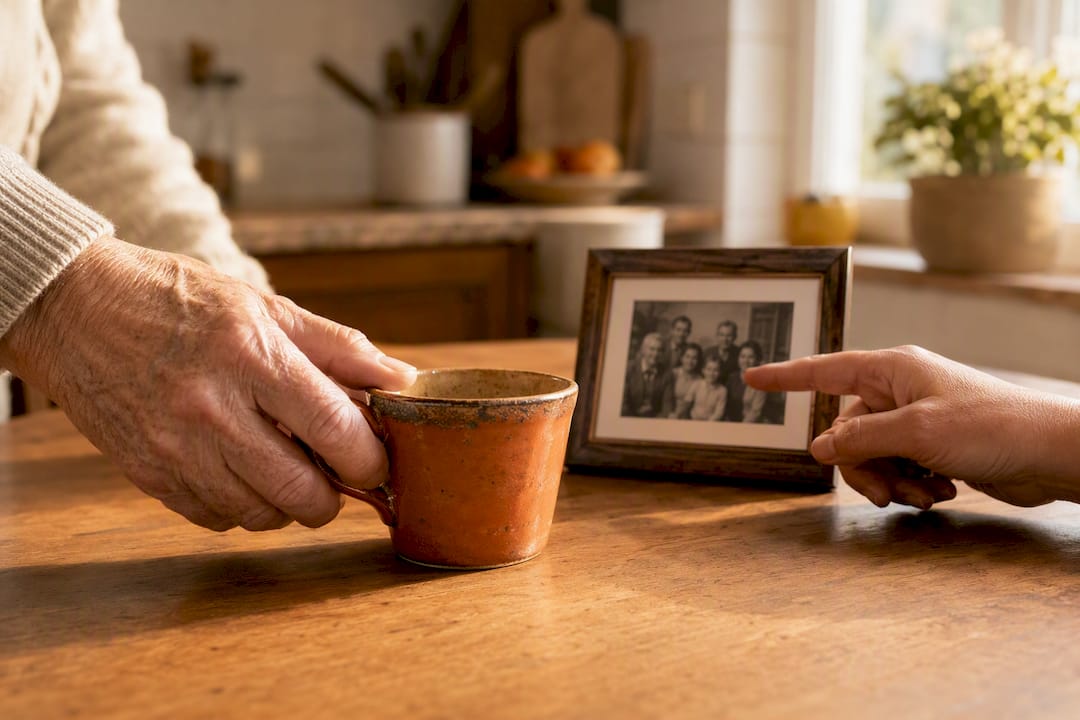
Imagine the orange cup Grandpa has used for years sitting on the table. Do not ask: “Tell me your life.” Ask: “Where did this cup come from?” Or point at the photo on the wall: “Who is that, and when was this?”
A smell, a song, a recipe does the same. Then it feels like a visit, not an appointment.
When it goes quiet
Memories can bring tears, even on a funny topic. Pause. Ask: “Shall we take a break?” Some people want to keep talking. Some need air. Both are fine.
Name a hard topic before you drop it in. “I would also like to talk about harder years, but only if you want to.” If the answer is no, move on. You are not in a test, and neither is Grandma.
Treat the questions as a guide for follow-ups, not a script you have to finish. If the garden comes up, ask about the garden. Not the next number on the sheet.
Interrupt rarely. Let silences stand. At the end it does not matter how many questions you got through. It matters whether they felt heard.
The voice stays. The text is only the map.
Record on the phone, in a quiet room. A TV in the background or a kitchen that echoes off hard surfaces makes the recording loud. A ten-second test with headphones shows whether you can hear Grandma. An extra microphone can help. It is not required.
The original file is the memory. A transcript helps you find a passage later. It does not replace the voice. How to keep that recording yourself is in how to interview parents. The same rule holds for grandparents.
In FamilyStories the recording stays on the family’s devices. Speech becomes text there, not at an outside service. FamilyStories cannot read the stories or listen to them. How that fits together is in end-to-end encryption for family archives.
A private guest link is different. An invited person can answer in the browser, without the app and without an account. The full link is a key: whoever has it can read and change the questions you opened for them. It is for answering, not a lasting address to pass around.
FamilyStories is for iPhone and iPad. An Android phone is enough for a recording. The guided questions and the private collection live in the app.
What FamilyStories changes about this talk
A paper list and five voice notes on a phone fall apart. Later you cannot tell which question belongs to which file.
FamilyStories keeps the question, the voice, the text, and the photo in one private place. The questions can be tailored to the person. Grandma can answer on your phone in the app, in her own app after an invite, or through the guest link in the browser. Up to ten people can help in one private circle. With a paid plan you can take the stories out as Word or PDF. You can also download the original voices.
That does not replace the kitchen table. It only stops the story of the cup from disappearing between the notes.
Frequently asked questions
Open questions tied to a concrete picture. “What did your childhood house look like?” goes further than “Were you happy as a child?” A photo or a cup on the table often does the same job.
Childhood, family, and what they want the grandchildren to keep. Name harder years first and skip them if someone does not want to. You do not have to finish a whole life in one hour.
Ten to twelve for thirty to sixty minutes. Send one to three of them a few days ahead. If one story fills the afternoon, that is not a mistake.
Ask permission. Put the phone where they can see it. Record in a quiet room and test ten seconds. Keep the original file. The text is only for finding a passage later.
Yes, through a private guest link in the browser, with no account. The link is a key for the opened questions. Give it only to the person who should answer.
Preserve the stories that make your family unique
FamilyStories turns thoughtful questions into a private place for your family’s voices, photos, and memories.
- End-to-end encrypted
- Personalized questions you can edit at any time
- Text and voice answers with automatic transcription
- Upload unlimited photos
- A family tree that connects people and stories
- Weekly or monthly reminders
- Answer in the app or securely in a browser via a link
- Preserve each family member’s original voice
- Download the app
Open our homepage and start FamilyStories from there.
- Choose your questions
Choose personal questions and adapt them to your family at any time.
- Invite your family
Share a secure link or invitation code and capture the first story together.