


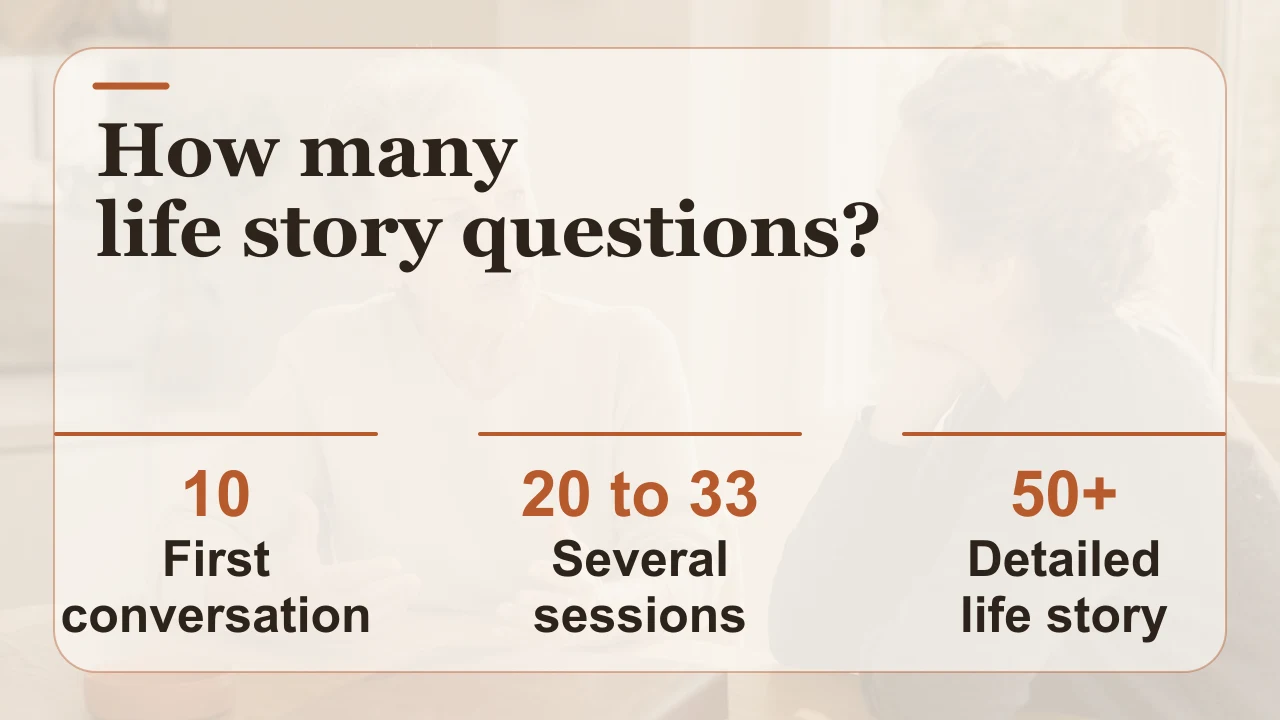
Ten well-chosen life story questions are often enough for a first conversation. A set of 20 to 33 works well across several visits, while a detailed life story project benefits from a flexible bank of 50 or more. The goal is not to finish every question. Open prompts should help memories, scenes, and personal connections emerge naturally.
Table of contents
- Which question set fits your situation?
- How do you lead a conversation that goes deeper?
- Life story questions by stage of life
- How do you approach painful memories?
- How to preserve the stories for the future
- What a guided conversation can change
- Organizing life story questions privately
- Frequently asked questions
- Sources
Which question set fits your situation?
The right number of questions depends on how comfortable you and the person sharing their story feel with this kind of conversation, and how much time you have together. A short selection can spark a vivid conversation. A long list only works when it is spread across several sessions.
Ten questions for an easy first conversation
A set of ten questions works well for a spontaneous visit, a quiet chat over coffee, or a gentle first attempt. No one has to commit to a major project, and you will quickly notice which subjects bring back the most memories.
You might begin with:
- What did your home look like when you were a child?
- Which song reminds you of your youth?
- Who had a strong influence on you, and why?
- What do you wish you had known at 20?
- Which meal makes you think of home?
- When did you have to be especially brave?
20 to 33 questions for several conversations
A medium-sized set can sustain a memory project over several weeks. Formats such as “Traces of Your Life” show that as few as 20 well-chosen questions can bring connected stories to the surface. You can divide different stages of life among several short conversations.
For example, ask: “Which decision changed the course of your life most?”, “What worried or challenged you when you were young?”, or “What advice would you give your 18-year-old self?”
50 or more questions for a detailed life story
A large set helps you cover childhood, school, work, relationships, turning points, and later years in a structured way. These collections are a resource for many sessions, not a questionnaire for a single evening. Working through a long list in a few hours usually produces short answers instead of vivid stories.
How do you lead a conversation that goes deeper?
A thoughtful sequence and genuine listening create a good life story conversation. Guides to biographical work recommend quiet sessions of about 30 to 60 minutes. This leaves enough room for detail without exhausting the person who is sharing their story.
- Prepare first. Decide what you hope to learn, test the recording, and choose a familiar place where no one feels rushed.
- Start gently. Begin with childhood memories, favorite meals, or familiar places before moving toward emotionally difficult subjects.
- Share one of your own memories. A brief personal connection turns an interview into a conversation between equals.
- Ask about other perspectives. A question such as “What do you think that decision meant for your mother?” can open new perspectives on family relationships.
- Allow pauses. Do not immediately move to the next question after an answer. More details often appear in the silence.
If an answer stays very short, “How did that feel for you?” is often more helpful than a factual question beginning with “Why?”
Life story questions by stage of life
Organizing questions by life stage helps prevent important periods from being missed. Life history questionnaires often follow a timeline, and that structure can also be adapted for personal family conversations.
Childhood and home
What did your childhood home look like? Who cared for you when your parents were working? Which game did you especially enjoy? Was there someone outside the family who influenced you?
Teen years and first independence
What was school like for you? Which friendship from that time has stayed with you? What did you rebel against? What did you dream about before adult life began?
Work and decisions
How did you get your first job? What changed most in your work over the years? Which decision would you make differently today?
Relationships and family
How did you meet your partner? Which people mattered most in your life? What kept you connected during difficult times?
Turning points and later years
Which event changed your path most? What would you still like to experience? Which lesson would you like to pass on to younger relatives?
War, displacement, or migration may be part of this timeline, but they require particular care. Begin with everyday life, places, and facts. The person telling the story decides which memories they want to explore more deeply.
How do you approach painful memories?
Not every memory is ready to be shared. A respectful conversation lets the person telling the story remain in control of the subjects, pace, and pauses at all times.
- Agree beforehand whether the conversation should be recorded and who may listen to it later.
- Make it clear that any subject can be skipped without an explanation.
- Take a break if the person seems tense, very quiet, or tired.
- Ask whether they would like to continue later or leave the subject aside entirely.
- Offer them a copy of the recording or finished text if they would like one.
Completeness is not the goal. Safety, trust, and a positive experience together matter more than any unanswered question.
How to preserve the stories for the future
Audio recordings preserve tone, pauses, and laughter, while a transcript is easier to search, organize, and arrange into chapters. A quiet room usually matters more than expensive equipment. A smartphone is often enough, although an extra microphone can help in a larger room.
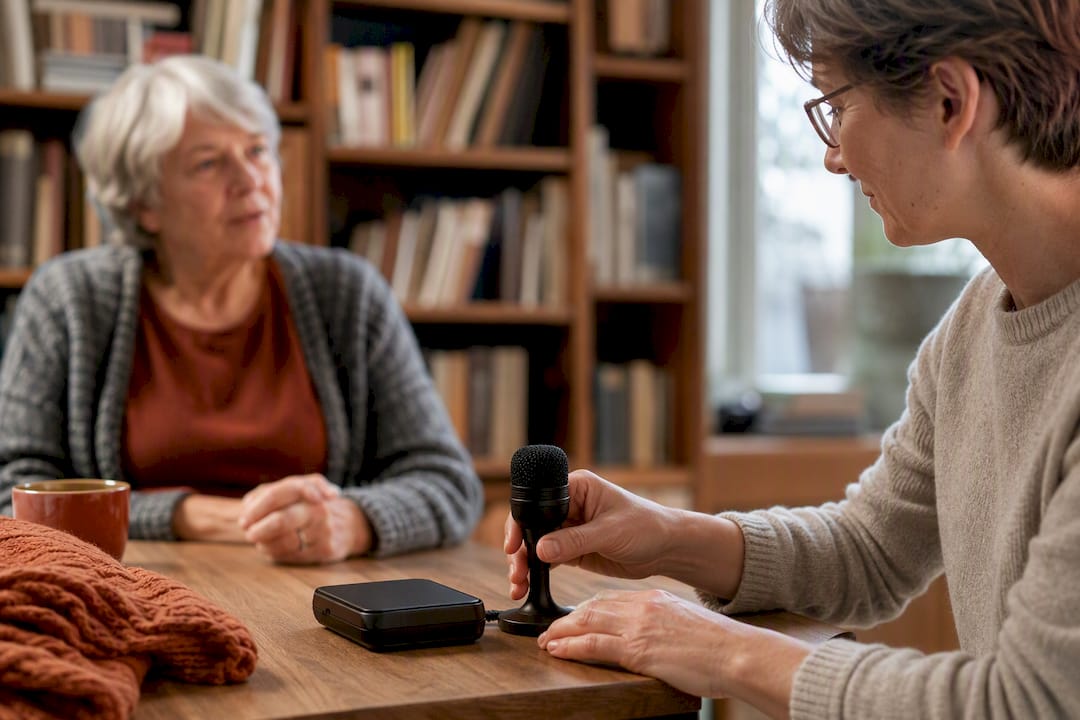
For each recording, note the date, place, people involved, and subject. These details later turn separate files into a collection that makes sense. Transcribe voice recordings soon afterward and check names, places, and dialect words while the context is still fresh.
Children and teenagers who know their family stories often develop a stronger awareness of their family history, according to an Emory University article on family stories. In any case, a clear filing system is worthwhile because it keeps conversations, photos, and original voices together.
A practical process looks like this:
- Note the date, person, place, and subject for each recording.
- Create a transcript soon afterward and correct proper names.
- Keep the recording, transcript, and related photos together.
- Export completed chapters regularly as Word or PDF files.
What a guided conversation can change
The real value is not a flawless collection of facts. It is the closeness that can grow when you remember together. A question about a first job, for example, may reveal a decision that went on to shape later generations. Connections like these rarely emerge from a rigid list. They come from thoughtful prompts, follow-up questions, and patience.
Short, regular conversations often achieve more than a single long afternoon. Memories have time to settle between sessions. By the next meeting, the person telling the story may remember new names, places, or moments.
Organizing life story questions privately
FamilyStories combines personalized questions that you can edit at any time with written answers, photos, and voice recordings. Spoken answers are automatically transcribed while the original voice is preserved. A family tree connects people with their stories.
You can invite up to ten relatives into a private family circle. Someone can answer directly on the interviewer's device, join in their own app with an invitation code, or share their story without the app through a private browser link. Content is protected with end-to-end encryption. With a paid plan, completed stories can be exported as Word or PDF files. Questions, answers, and media stay together in one place, leaving you free to focus on the conversation.
If you would like to prepare your first conversation, our guide to family interview questions, scripts, and a recording checklist can help.
Frequently asked questions
Begin with specific, comfortable scenes: the childhood home, a typical Sunday, favorite foods, friendships, school, a first job, influential people, courageous decisions, family traditions, and advice for a younger self. Choose only the prompts that suit the person and situation.
Six to ten open-ended questions are often enough for a first conversation. A set of 20 to 33 provides a good framework for several meetings. A detailed life story project may contain 50 or more questions, but they should be spread across several conversations.
Begin with easy, specific memories from childhood and everyday life. Then move on to adolescence, work, relationships, and turning points. Personal or painful subjects should wait until enough trust and calm have developed.
Ask for a specific scene and invite details about sounds, smells, people, or feelings. Allow a moment of silence after the answer. A calm follow-up such as “What happened next?” often opens up more than moving straight to the next question.
Organize each recording by date, person, place, and subject. Keep the audio, transcript, and related photos together. FamilyStories can bring these materials together in a private family circle protected with end-to-end encryption.
Keep your family's stories, in their own voices
FamilyStories is the iPhone and iPad app where your family collects life stories: with personal questions, real voices and photos, kept private, and in the end a printed book.
- Personal questions by chapter of life
- Spoken words become text automatically
- The original voice is always kept
- Photos right next to their story
- A family circle for up to 10 people
- Answer without the app, by link
- Weekly reminders to keep telling
- Music and nature sounds as you talk
- A family tree for the whole family
- Save it as a PDF or a Word file
- A printed book, shipped worldwide
- Private and end-to-end encrypted
- Download the app
Get FamilyStories from the App Store on your iPhone or iPad.
- Pick the questions
Tell the app a little about the person, and it picks fitting questions.
- Invite your family
Send your family a link. They answer in the app or in their browser.
Sources
- How family stories help children through difficult times, Emory News Center
- Researching family history: The right questions open doors to the past, Biografissima
- Conversation guide for biographical work, PQSG
- Life history questionnaire, Noelke Psychotherapy
- Traces of your life: 20 biographical questions, beziehungsweise