


To document family values is to keep a story a grandchild could still understand, not a word on the wall. A poster that says respect, honesty, and togetherness names a wish. A voice that tells why leftover bread never went in the trash holds the value itself.
What a family value actually is
A value is what decided a concrete moment. It is not the label you later put on it.
Imagine your mother describing her grandmother's Sunday kitchen. Bread was not thrown away, guests were served first, and anyone late still found a plate. If you later hang only "generosity" on the fridge, the word remains. If you keep the voice and the kitchen, the value remains.
US pages on this topic usually ask you to write a statement. Evaheld's family values statement guide walks families through prompts and a short list of principles to live by. Legacy letters do similar work in writing. Family Heritage Hub is closer: one person, one specific question, one recorded answer. Even there, values sit as one theme among many life-story prompts, not as a capture method of their own.
A values statement helps a household decide how to live now. It does not keep what an older person has already lived. A grandchild who never met your grandmother can do little with "reliability." They can do something with the night she still opened the door because someone had lost a key.
If you came for a family values statement, Evaheld already walks that worksheet. On this page, documenting family values means what those worksheets leave open: one already lived scene, in the original voice, attached to an object, while the person can still tell it.
Three questions that make a value concrete
You do not need a whole-life interview. That craft lives under how to interview parents. This page is only about the value.
Three questions are enough, in this order:
- What really mattered to you, even if nobody named it that way?
- When did you first see it, or act that way yourself?
- What of that should someone in our family still be able to understand later?
The first question finds the value without a word list. The second turns it into a scene. The third separates what should remain from what only sounds nice.
If the person stalls, pick up an object. A recipe, a tool, a letter. Then "we stuck together" often becomes: when the shop closed, we did not sell the carpenter's plane.
Short, regular voice recordings keep tone and pause that no statement can carry. Fifteen clear-headed minutes on a weekday afternoon are worth more than a planned marathon that never happens.
Objects, recipes, and letters as anchors
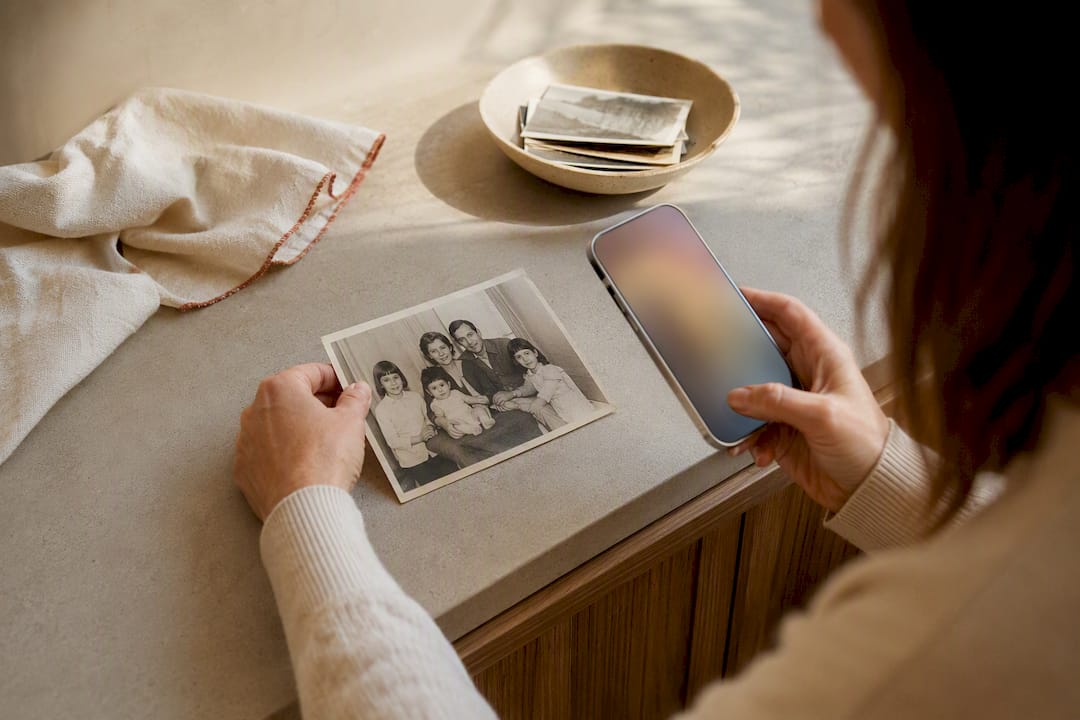
A value often lives on a thing that otherwise sits in a drawer. The photo alone shows faces. The story shows why the photo stayed in the house.
Letters, recipes, or everyday objects give a family story the depth that names and dates cannot. A recipe explains why nothing was thrown away better than the word thrift. A letter shows how someone spoke in a hard year. A tool explains why work in your family was a form of care.
Photograph the object, and attach the recording to the same place. Then a later reader finds both: the picture and the voice.
Automatic family books and AI summaries can turn that into a smooth page. They do not choose which scene is the value. Even where tools offer a starting draft, the conceptual work is still done by hand. You choose which story stays. A generator chooses what reads well.
Family-business writers make the same point in another room: a value statement on a website stays abstract until someone can tell the story that shows it. That is true at a kitchen table as well.
How to store the story so the voice remains
A value you only write down in your own words becomes your summary. The original voice holds dialect, pause, and the laugh in the kitchen.
Keep three things in one place:
- the recording or the text in the person's words
- the object or the photo that belongs with it
- a short note of who is speaking, when, and what the scene is
This is not a backup tutorial. If you want the 3-2-1 rule for photos, that lives under 3-2-1 family photo backup. Here, something else matters: the voice must not vanish in a memo folder while the word survives on a poster.
A transcript helps you find the passage later. It is not a replacement for the file.
If you later want a bound copy in your hands, you can upload the finished file to a book printer. FamilyStories is honest about that path: Word or PDF from a paid plan, plus photos and original voices. There is no printed family book inside the app.
How FamilyStories asks about values
The open question "What are your values?" often produces a list. FamilyStories has a card called Your Values. Open it and start with: Which beliefs or values have carried you through life, and what should future generations look to for guidance? Let the person answer in their own words, as voice or as text. Attach the photo of the recipe or the carpenter's plane to that same answer. If they stall, ask the next question: Was there a time when you stood up for a person, a cause, or something you believed in?
Answers are text or voice. The original voice remains. A written transcript helps you find the place later. The photo belongs on the same answer, not in another folder.
Up to ten people share a private family circle. Someone who does not want the app can speak through a private guest link in the browser, with no account. Everything stays encrypted from end to end. FamilyStories shows no ads, does not sell data, and does not use family content to train artificial intelligence.
The app is for iPhone and iPad. The full life-story arc belongs on record your parents' life story. This page only covers how a value survives as a story.
Frequently asked questions
No. A list describes what you wish for. A story shows how someone lived it. Keep the story if you want to document the value.
What mattered, even without the word. When did you see it. What should still be understandable later. Then you can be quiet. The scene often arrives in the pause.
No. A chronicle collects the whole arc. A value needs a scene, an object, and the voice. The book can come later. That path is in print a family history book.
You can invite someone through a private guest link in the browser. The link opens only the shared questions. Share it only with people you trust.
Not from the app. With a paid plan you export Word or PDF, photos, and original voices. If you want it bound, you upload that file to a print service.
Preserve the stories that make your family unique
FamilyStories turns thoughtful questions into a private place for your family’s voices, photos, and memories.
- End-to-end encrypted
- Personalized questions you can edit at any time
- Text and voice answers with automatic transcription
- Upload unlimited photos
- A family tree that connects people and stories
- Weekly or monthly reminders
- Answer in the app or securely in a browser via a link
- Preserve each family member’s original voice
- Download the app
Open our homepage and start FamilyStories from there.
- Choose your questions
Choose personal questions and adapt them to your family at any time.
- Invite your family
Share a secure link or invitation code and capture the first story together.
Sources
- How to Preserve Family Stories for Future Generations (Family Heritage Hub)
- Family Values Statements: Prompts and Examples (Evaheld)
- Storytelling Vividly Illustrates Your Family Business Values
- How can life memories be preserved? (zuhause betreuen)
- Writing family stories and family chronicles (Silvia Dießner)
- The digital family chronicle (Transkriber)
- Create and print a family chronicle (epubli)