

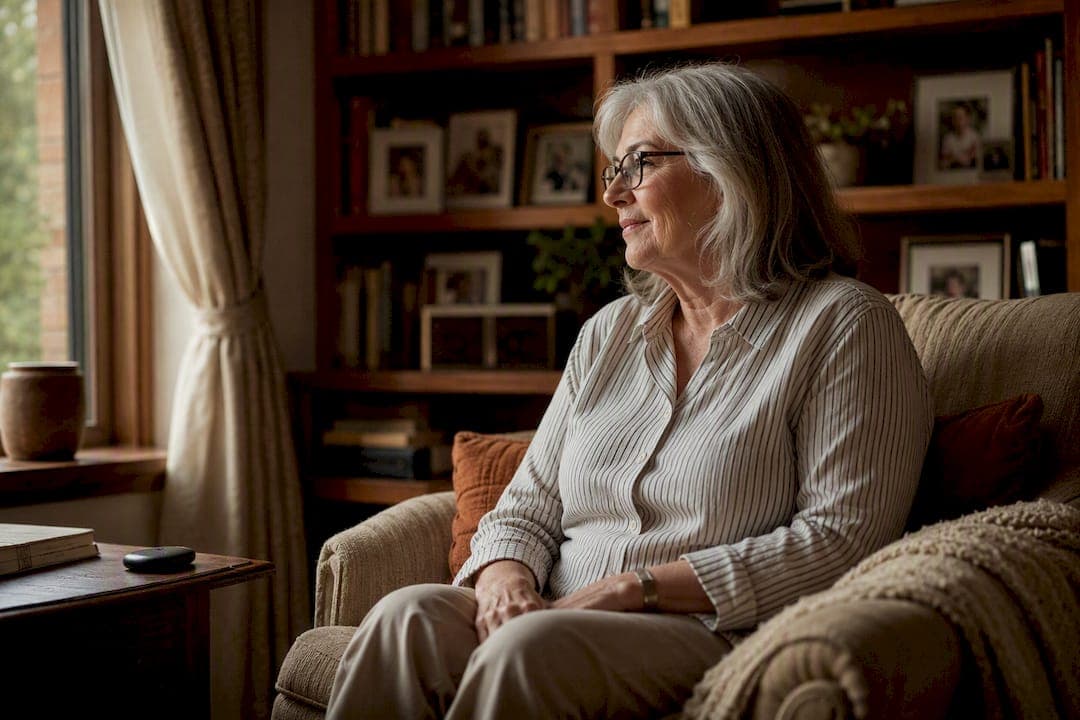
Life review questions for older adults work best when they feel like a real family conversation, not a formal interview. A quiet room, one familiar topic, and 40 to 60 minutes are often enough to uncover a story worth keeping.
The goal is not to document an entire life in one sitting. It is to make space for the details that usually disappear first: the sound of a childhood home, a favorite meal, a first job, or the person who offered help at exactly the right time.
Table of contents
- What does a life review look like at home?
- How do you prepare a comfortable conversation?
- Which questions bring memories to the surface?
- How can you structure 40 to 60 minutes?
- How do you preserve both words and voice?
- What should happen after the first conversation?
- Frequently asked questions
- Sources
What does a life review look like at home?
At home, a life review can be as simple as looking through one photo album and asking what happened just before a picture was taken. The conversation may move between memories, feelings, and family relationships. It does not need to follow a timeline.
Professional resources describe life review and reminiscence as ways to reflect on experiences and meaning. Within a family, the same basic idea can remain warm and informal. The practical guidance on biographical work with older adults from Sozial.de is useful background even though it is written in German.
How do you prepare a comfortable conversation?
Pick a time when neither person needs to rush away. Sit somewhere familiar and bring one or two memory prompts, such as a photograph, a letter, a recipe card, or an object from a former home. A concrete prompt makes the first question easier.
Decide whether you will take notes or record audio. Charge the phone, silence notifications, and keep water nearby. The family interview guide from Grossvater.de also recommends starting with a manageable set of questions.

Which questions bring memories to the surface?
Open questions need enough focus to feel easy to answer. Try prompts like these:
- What did the home you grew up in feel like?
- Who made you feel understood when you were young?
- Which food or smell takes you back immediately?
- When did you first feel truly independent?
- Which choice changed your life more than you expected?
When a detail appears, stay with it. “What happened next?” and “What do you remember most clearly?” often lead to richer answers than moving down a list. Our guide to questions to ask parents about their life offers more natural conversation starters.
How can you structure 40 to 60 minutes?
A light structure keeps the conversation focused without making it rigid:
- Settle in for five minutes. Talk about the day and name the theme.
- Use a memory prompt for ten minutes. Look at a photo or familiar object together.
- Stay with one story for 20 to 30 minutes. Ask about people, sounds, feelings, and what changed afterward.
- Organize the details for ten minutes. Confirm names and approximate dates.
- Close gently for five minutes. Choose something enjoyable to revisit next time.
If energy drops sooner, stop. A shorter conversation can still preserve something important. The AOK overview of biographical work also emphasizes adapting the pace to the individual.
A small detail such as the smell of fresh bread can carry more family history than a long list of dates.
How do you preserve both words and voice?
Notes are useful for names and chronology. Audio also keeps laughter, accent, pauses, and tone. After the conversation, add a short title and a sentence explaining who was present and what prompted the story.
FamilyStories combines personalized questions with written and voice responses. Speech is automatically turned into text while the original recording remains part of the memory. After the App Store launch, relatives can respond in the app or through a secure browser link. Our guide to recording your parents' life story explains how separate answers can grow into a coherent portrait.
What should happen after the first conversation?
Let the next topic come from something mentioned naturally. A sibling, workplace, celebration, or journey can become the opening for the next session. This creates continuity without forcing a strict chronology.
A short recurring rhythm is easier to sustain than one large project. Weekly or monthly conversations can gradually cover childhood, school, work, relationships, traditions, and values. The Livento introduction to biographical work provides additional practical prompts.
Frequently asked questions
Three to five main questions are usually enough. Follow-up questions that come from the answers matter more than completing a long list.
Move to another subject or end the conversation. A memory can remain private. Trust matters more than completeness.
Both can work together. Audio preserves the voice, while brief notes mark names, places, and details to check later.
Choose a rhythm that feels easy for both people. Every two or four weeks can work just as well as a short weekly session.
Keep your family's stories, in their own voices
FamilyStories is the iPhone and iPad app where your family collects life stories: with personal questions, real voices and photos, kept private, and in the end a printed book.
- Personal questions by chapter of life
- Spoken words become text automatically
- The original voice is always kept
- Photos right next to their story
- A family circle for up to 10 people
- Answer without the app, by link
- Weekly reminders to keep telling
- Music and nature sounds as you talk
- A family tree for the whole family
- Save it as a PDF or a Word file
- A printed book, shipped worldwide
- Private and end-to-end encrypted
- Download the app
Get FamilyStories from the App Store on your iPhone or iPad.
- Pick the questions
Tell the app a little about the person, and it picks fitting questions.
- Invite your family
Send your family a link. They answer in the app or in their browser.