
A family story can be a five-minute voice recording, a photo album with short captions, or a shared digital collection that grows over time. You do not need a studio or reporting experience to begin. These family story examples show how one thoughtful question, a calm conversation, and secure storage can become something your family will return to.
Table of contents
- Six family story examples you can make your own
- How to prepare a family interview
- How to record and store family stories safely
- When a traditional interview is not the right fit
- A conversation that uncovered more than expected
- Why technology is rarely the biggest obstacle
- Frequently asked questions
- Sources
Six family story examples you can make your own
Not every family wants to write a book. One family may want to save a grandmother's voice for younger grandchildren, while another is planning an 80th birthday gift. These six formats are practical starting points.
- Interview transcript: Ask a handful of prepared questions, record 20 to 60 minutes, and turn the conversation into text later. The scope is manageable even for a first attempt.
- Audio highlights: Select a few meaningful clips about a first home, school days, or a wedding. The result is a personal recording that keeps the person's voice at the center.
- Memory album: Combine photographs, small keepsakes, and short notes. Visual prompts can bring back details that a broad question may not, as this guide to biographical memory work explains.
- One-page life sketch: Put the major stages of a life in chronological order. It can accompany a birthday gift or become the outline for a longer story.
- Multimedia family collection: Gather text, voice recordings, photographs, and family relationships in one private space where relatives can contribute gradually.
- Story of the month: Ask one question on a regular schedule. Twelve small entries can become a surprisingly rich collection by the end of a year.
The best format depends more on the occasion than on technical skill. A birthday gift may need a clear ending. A living family archive can remain open and continue to grow.
How to prepare a family interview
Trust has more influence on a good interview than the recorder. A brief explanation before you start usually leads to fuller, more honest answers.
- Set the frame: Explain the purpose, approximate length, and who in the family will be able to hear or read the recording. The FernUniversität Hagen interview guidelines also emphasize clear preparation.
- Begin chronologically: Start with childhood, then move through school, work, relationships, and later years. “What did your childhood home look like?” provides direction without suggesting an answer.
- Ask open questions: Who, how, what, and why invite a story. The Ruhr University Bochum interview guidelines likewise recommend avoiding leading questions.
- Follow up and allow silence: “What would your mother have said about that?” can reveal another point of view. Eva Helms offers more family history prompts.
- Document simply: Note the date, place, person, and occasion. Together with the recording, that is enough metadata for a strong start.
Check the battery and record a few seconds of test audio. You can also practice attentive listening with someone else first. This training module from the city of Jülich includes practical listening exercises.
How to record and store family stories safely
A smartphone is enough for most family interviews. A quiet room and a microphone close to the speaker usually improve the result more than expensive accessories.
- Recording: A standard voice memo in MP3 or WAV is a perfectly useful starting point.
- Backup: Do not rely on one device. Keep a local copy and an encrypted backup in case a phone is lost or replaced.
- Organization: Add the date, place, person, and a short topic so every recording can be found later.
- Export: Text can be collected in a PDF while separate audio files preserve the original voice.
People share more openly when the space feels private. FamilyStories protects text, photos, and voice recordings with end-to-end encryption. If you need conversation starters, see these questions to ask your parents about their life.
When a traditional interview is not the right fit
Not every conversation moves neatly from childhood to the present. Dementia, fatigue, or emotionally difficult memories may call for a gentler approach.
- Photographs, music, scents, and familiar objects often provide an easier starting point than exact dates.
- Several short conversations can feel more comfortable than one long interview.
- Repetition does not need to be corrected. It may show which memory carries the most meaning.
- A smile, a pause, or a gesture can also become part of the story.
If a subject becomes overwhelming, pause or move to a safer memory. You can continue another day. Completing the timeline is never more important than maintaining trust.
A conversation that uncovered more than expected
A few old photographs were placed on the table and the recorder had been tested. The conversation with a grandfather was supposed to last only an hour.
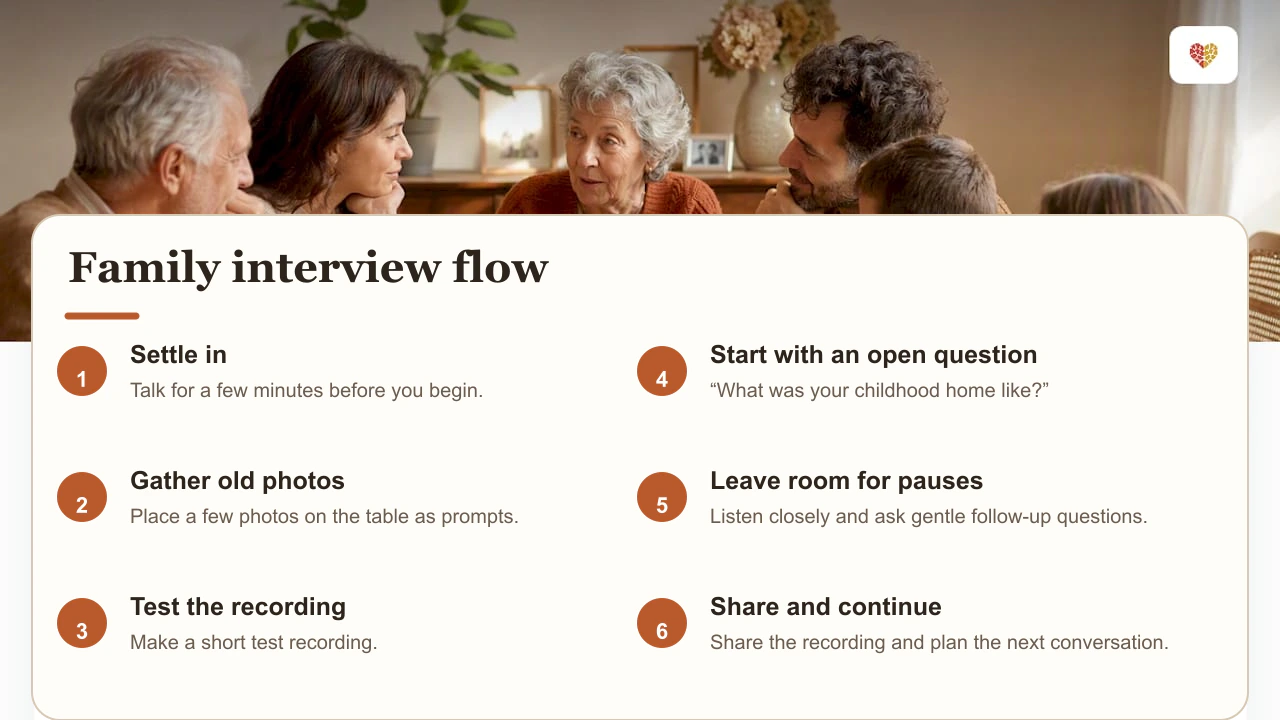
The first question was simple: “What did your childhood home look like?” A description of the house became a story about losing his father during the war, something he had never discussed with the family. After a long pause, the recording continued for two hours. Three siblings heard those details for the first time. What began as a one-time interview became a regular Sunday conversation the entire family now looks forward to.
Why technology is rarely the biggest obstacle
Many relatives hesitate because they think they need professional equipment or interviewing skills. More often, the real obstacle is feeling unsure about asking. They do not want to demand too much or touch a painful subject.
The best recordings do not come from perfect questionnaires. They come from genuine interest and a willingness to let silence do its work. Technology is only the tool. Listening is the real task.
Do not begin with twenty questions. One good question, one calm follow-up, and another conversation next week will often reveal more.
Preserving family stories with FamilyStories
FamilyStories brings personalized, editable questions together with text, photos, and voice recordings. Spoken answers are transcribed automatically while the encrypted original voice is preserved. A private family tree connects people with their stories, and up to ten relatives can contribute depending on the plan.
The storyteller can answer on the interviewer's device, join the app with an invitation code, or respond without installing an app through a private browser link. Technology stays in the background, leaving more room for the conversation. Our guide to recording your parents' life story shows how separate answers can become a coherent portrait.
Frequently asked questions
A short interview or a single voice recording is usually the simplest start. You can always organize, expand, or turn the material into an album later.
Five to eight open questions often fill 30 to 60 minutes. Thoughtful follow-ups matter more than a long list.
Yes. Choose a quiet room, place the phone near the speaker, and record a brief test before the conversation begins.
Try photographs, music, or familiar objects. Keep the conversation short and return to the subject on another day.
Label every entry with a person, date, place, and topic. A shared structure or family tree can connect the individual memories later.
Keep your family's stories, in their own voices
FamilyStories is the iPhone and iPad app where your family collects life stories: with personal questions, real voices and photos, kept private, and in the end a printed book.
- Personal questions by chapter of life
- Spoken words become text automatically
- The original voice is always kept
- Photos right next to their story
- A family circle for up to 10 people
- Answer without the app, by link
- Weekly reminders to keep telling
- Music and nature sounds as you talk
- A family tree for the whole family
- Save it as a PDF or a Word file
- A printed book, shipped worldwide
- Private and end-to-end encrypted
- Download the app
Get FamilyStories from the App Store on your iPhone or iPad.
- Pick the questions
Tell the app a little about the person, and it picks fitting questions.
- Invite your family
Send your family a link. They answer in the app or in their browser.